
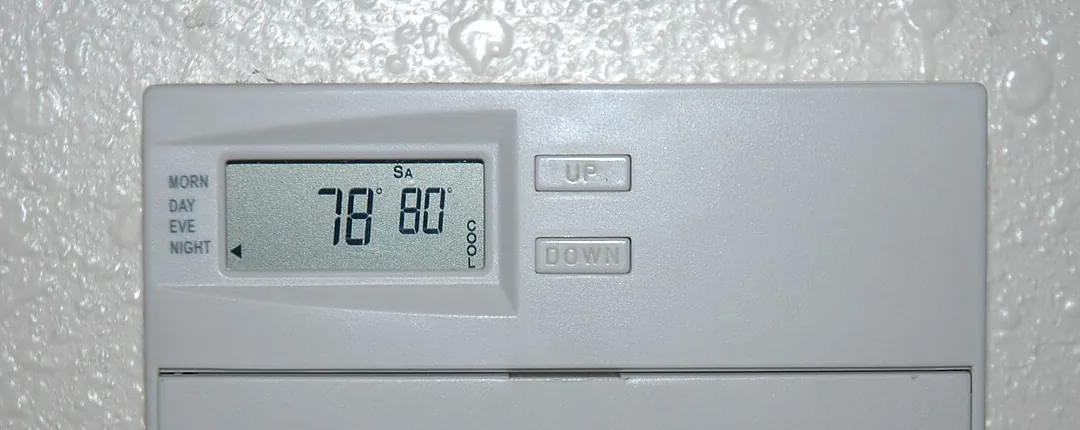
A programmable thermostat that drops too far while a house or a wing sits empty is a common midwinter water loss. The split often happens in a little-used bath, a guest addition, or a shop that was never on the same heat loop as the main rooms. This guide is about that pattern.
By Chester County Water Damage
If a line has already split, shut the water if you can do so safely and call (484) 293-9465. We handle frozen and burst pipe cleanup around the clock in houses and in workplaces.
Why a “reasonable” setback still fails a remote room
Heat setbacks save fuel in rooms you use. They are less kind to a pipe that runs through an uninsulated rim, a crawl, a garage ceiling, or an addition that was finished later. When the occupied core stays comfortable and a far bathroom sits near the outdoor temperature, the first hard night of a trip can freeze that line. The thaw then releases the water, sometimes hours after you have already left.
Rural and large-lot properties in places such as Chester Springs show this clearly: a guest house, a workshop, or a long crawl can be on a different thermal island than the kitchen. Main Line houses see a milder version in rear additions and poorly insulated eaves.
Workplaces have a close cousin: an unoccupied wing taken off a boiler loop over a holiday weekend. Facilities staff should treat that as a freeze risk, not only a energy-saving habit.
A short checklist before you leave in winter
| Check | Why it matters |
|---|---|
| Thermostat floor, not a deep setback in a vacant building | Remote rooms cool faster than the hallway sensor |
| Cabinet doors open on sink lines that share an exterior wall | Still air behind a vanity is a classic freeze pocket |
| Hose bibs drained and indoor shutoffs closed | An unsheltered spigot can split and feed water indoors |
| Someone has a key and this phone number | A neighbor or manager can authorize extraction if a camera alert arrives |
| Heat stays on in shops and little-used wings | A “closed for the week” sign does not keep a line from freezing |
We are not a heating contractor. If a system is already unreliable, a service visit before a long trip is worth more than any article.
If you get an alert while you are away
A leak sensor, a high water bill alert, or a neighbor’s call should not wait until you “look first” next week. If a keyholder can meet a crew and you can authorize the work in writing, extraction can start. A short message with the address, the shutoff location if you know it, and a permission path is enough to begin. Photos of the first wet rooms still go in the file.
If no one can provide access, say so honestly. We cannot enter.
What the cleanup usually involves
After the water is stopped — sometimes by a plumber, sometimes at the main — the work is the cavities the spray reached, not only the room with the split. Water travels along joists and can show up in a ceiling below or a wall far from the break. That is why a moisture map matters more than a mop. Guide prices for typical house mitigation on this site remain in the $1,300–$5,500 band; a quickly isolated event can be smaller, and a long-running break in an empty building can be larger.
Holiday closures at a shop or office follow the same drying logic with different access rules. See commercial water damage.
What this page is not
It is not a promise that any particular thermostat setting will prevent a freeze. Local temperatures, insulation and piping routes vary. It is also not a claim about what a policy will pay. A sudden split is often discussed as a sudden, accidental event; a long vacancy with heat off can raise other questions. Your carrier decides.
After the thaw: where the water actually went
The split is only the starting point. Spray can travel along a joist bay and appear as a stain in a room that still looks dry at first glance. Cabinets, insulation and a lower-level ceiling deserve readings even when the break was in a powder room. We would rather map those assemblies than guess from the puddle alone.
One more habit that helps
If you travel often, a simple leak sensor near the water heater and the washer — plus a person who can meet a crew — is more useful than a deeper thermostat setback. Sensors do not stop a freeze, but they shorten the time a split runs unnoticed.
Frequently asked questions
How low is “too low” for a vacation setting?
There is no single safe number for every building. Ask a heating professional about your layout. Deep setbacks in vacant wings are a recurring intake note.
The break is in a garage or addition. Is that still a water job?
Yes. Tell us about the addition when you call so we bring the right inspection approach.
Can a tenant or neighbor let you in?
If the owner authorizes it and that person has a key, yes.
Do you also repair the pipe?
We dry and document. A plumber repairs the line. We can work in sequence if both trades are needed.
Are you available on a holiday night?
Yes. (484) 293-9465 is answered 24/7.
A line split while the building was empty? Call (484) 293-9465 — homes and workplaces.